


Construction projects rarely fail because of lack of materials or manpower. Many projects struggle because teams misunderstand the types of building drawing used in construction. Clear drawings serve as the language that connects architects, engineers, contractors, and clients. Research from the National Institute of Building Sciences shows that poor documentation and drawing misinterpretation contribute significantly to construction rework, which can cost up to 5–10% of total project value in some developments. Confusion between structural drawings, architectural plans, and service layouts often leads to costly errors on site. A wall built in the wrong position, misplaced electrical conduits, or incorrect foundation depth can quickly turn a well-planned project into a budget nightmare.
Many construction teams face these challenges daily. Engineers struggle to coordinate structural and mechanical drawings. Contractors encounter delays when site workers misread dimensions or elevations. Developers also lose valuable time when approvals are delayed due to incomplete documentation. Design teams sometimes produce drawings that are difficult for field workers to interpret, while project stakeholders expect clarity and accuracy from the start. These issues highlight the importance of understanding the types of building drawing and how each one supports the construction process from concept to completion.
This guide from Dutum Construction Company explains the important types of building drawing used in construction and how they guide every stage of a project. Each drawing plays a specific role in translating ideas into real structures. Clear explanations, practical examples, and professional insights will help developers, engineers, and project managers understand how these drawings work together to deliver safe, efficient, and high-quality buildings.
12 Types of Building Drawings Used in Construction
#1. Architectural Drawings
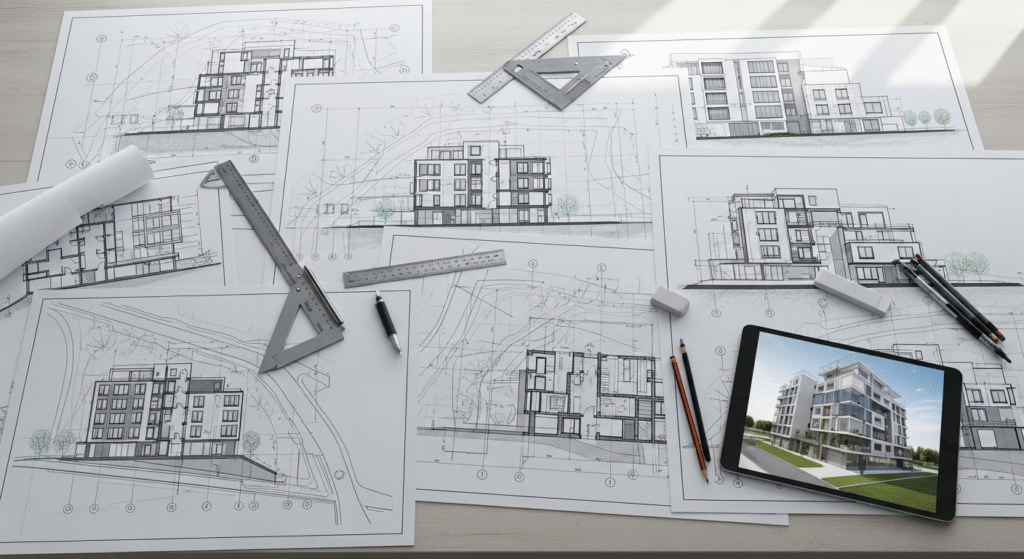
Architectural drawings represent the visual and functional design of a building. These drawings translate the architect’s concept into clear instructions that guide construction teams during project execution. Every major building project in Nigeria begins with detailed architectural documentation because it defines how spaces will be used and how the building will appear when completed.
Architectural drawings typically include several important elements that help construction teams understand the design clearly.
| Component | Purpose |
| Floor plans | Show the layout of rooms, corridors, and internal spaces |
| Elevations | Present the external view and appearance of the building |
| Sections | Reveal internal layers such as floors and wall structures |
| Door and window schedules | Provide dimensions and placement details |
Regulatory approval also depends heavily on these drawings. Planning authorities such as the Lagos State Physical Planning Permit Authority require architectural drawings before issuing building permits. Compliance ensures that buildings follow zoning regulations, setbacks, and development guidelines.
Clear architectural drawings reduce misunderstandings on site and help contractors deliver projects according to the approved design. Accurate documentation also improves communication between engineers, project managers, and clients.
#2. Structural Drawings
Structural drawings focus on the strength and stability of a building. These drawings specify the load-bearing components that support the entire structure, including beams, slabs, columns, and reinforcement bars. Structural engineers develop these drawings after analyzing building loads, soil conditions, and safety requirements.
Several critical elements appear in structural drawings.
| Structural Element | Description |
| Columns and beams | Show load-transfer framework |
| Reinforcement details | Specify steel bar sizes and spacing |
| Slab reinforcement | Define slab thickness and steel placement |
| Structural notes | Provide technical instructions for contractors |
Safety compliance is essential for structural design. In Nigeria, structural drawings are typically prepared and signed by professionals registered under the Council for the Regulation of Engineering in Nigeria. Professional validation ensures that the building meets national engineering standards and can withstand environmental loads.
Structural drawings play a critical role in preventing building collapse. Clear engineering documentation ensures that construction teams follow the correct reinforcement patterns, material specifications, and load calculations.
#3. Site Plan Drawings
Site plan drawings explain how a building fits within the surrounding land. These drawings guide construction teams and planning authorities in understanding the relationship between the structure and its environment.
Site plans usually include the following information.
| Site Feature | Purpose |
| Property boundaries | Define legal limits of the land |
| Access roads | Show entry and exit points |
| Drainage systems | Indicate water flow and stormwater control |
| Building setbacks | Ensure compliance with zoning rules |
Urban development regulations in Nigeria require accurate site plans before construction approval. Agencies such as the Lagos State Building Control Agency review these drawings to confirm that buildings follow planning regulations and safety requirements.
Proper site planning improves construction efficiency and prevents conflicts with neighboring properties. Well-prepared site plans also help engineers manage utilities, drainage systems, and access routes throughout the project lifecycle.
#4. Foundation Drawings
Foundation drawings provide detailed instructions for constructing the building’s base. These drawings guide contractors on how to transfer structural loads safely into the ground. Strong foundations are essential for preventing settlement, structural cracks, and long-term building failure.
Foundation drawings usually contain the following technical information.
| Foundation Detail | Purpose |
| Footing sizes | Specify dimensions of foundation pads |
| Excavation depth | Indicate how deep the foundation should go |
| Reinforcement layout | Show steel bar arrangement |
| Soil bearing references | Confirm the ground’s load capacity |
Construction teams often rely on soil investigation results before preparing foundation drawings. Geotechnical studies help determine the safe bearing capacity of the ground and influence the type of foundation used.
Professional oversight remains essential for this stage of construction. Engineers registered with the Nigerian Society of Engineers typically supervise foundation design and implementation to ensure compliance with engineering standards and safety requirements.
Foundation drawings, therefore, serve as one of the most critical types of building drawing used in construction, providing the technical roadmap that supports the entire structure above ground.
#5. Floor Plan Drawings
Floor plan drawings present a detailed top view of each level of a building. These drawings help architects, engineers, and contractors understand how internal spaces are arranged before construction begins. Every wall, doorway, corridor, and room layout appears clearly in the drawing, making it easier for site teams to follow the design accurately.
Floor plans play an important role in space planning and functionality. Developers use them to ensure that rooms are properly sized and circulation areas are practical for occupants.
| Floor Plan Element | Purpose |
| Room layout | Shows the arrangement of bedrooms, offices, kitchens, etc. |
| Door and window placement | Defines access points and ventilation |
| Dimensions | Provides accurate measurements for construction |
| Circulation areas | Displays hallways, staircases, and movement paths |
Planning authorities in Nigeria often require floor plans when reviewing building permit applications. Agencies such as the Lagos State Physical Planning Permit Authority examine these drawings to confirm compliance with building setbacks, occupancy standards, and land-use regulations.
Accurate floor plan drawings therefore remain one of the most important types of building drawing used in construction because they guide both design approval and on-site construction.
#6. Elevation Drawings
Elevation drawings display the external appearance of a building from different sides. These drawings show how the structure will look from the front, rear, and sides once construction is completed. Developers and architects rely on elevations to communicate architectural style, proportions, and façade details.
Elevation drawings help construction teams visualize building height and external finishes.
| Elevation Feature | Description |
| Front elevation | Shows the main façade of the building |
| Side elevations | Present the left and right views |
| Rear elevation | Displays the back view of the structure |
| External finishes | Indicates materials such as plaster, glass, or cladding |
Urban development agencies often review elevation drawings to ensure that buildings align with approved architectural standards. Regulatory authorities such as the Lagos State Building Control Agency assess these drawings to confirm that building heights, façade elements, and external features comply with planning regulations.
Elevation drawings therefore help both regulators and construction teams visualize how the finished structure will appear within its environment.
#7. Section Drawings
Section drawings provide a cut-through view of a building, revealing internal structural layers that cannot be seen in floor plans or elevations. Engineers and contractors rely on these drawings to understand the vertical relationship between floors, ceilings, walls, and roof systems.
Section drawings help explain how different construction elements interact within the structure.
| Section Detail | Purpose |
| Floor levels | Show vertical height differences between floors |
| Wall construction | Reveal material layers inside walls |
| Roof structure | Illustrate rafters, beams, or trusses |
| Staircase connections | Show vertical movement within the building |
Accurate section drawings are important for quality control and structural safety. Professional engineers often prepare these drawings in line with engineering standards regulated by the Council for the Regulation of Engineering in Nigeria. Compliance ensures that the building’s internal structure meets safety and load distribution requirements.
Section drawings therefore provide deeper technical insight into the internal structure of buildings and remain a critical component of construction documentation.
#8. Electrical Drawings
Electrical drawings illustrate how power systems are distributed throughout a building. These drawings guide electricians and engineers during installation of lighting systems, power outlets, wiring routes, and electrical panels.
Modern construction projects depend on accurate electrical drawings to ensure safe and efficient power distribution.
| Electrical Component | Function |
| Lighting layout | Shows positions of lighting fixtures |
| Socket outlets | Indicates power supply points |
| Wiring routes | Displays cable pathways |
| Distribution boards | Identifies electrical control panels |
Electrical installations must follow national safety standards in Nigeria. Regulatory oversight often falls under the Nigerian Electricity Regulatory Commission, which promotes safe and reliable electrical infrastructure across the country.
Well-prepared electrical drawings help construction teams avoid wiring errors, reduce safety risks, and ensure that buildings meet required electrical standards. Electrical layouts therefore remain a vital category among the types of building drawing used in modern construction projects.
#9. Plumbing and Drainage Drawings
Plumbing and drainage drawings explain how water moves through a building. These drawings show the layout of clean water supply lines, wastewater pipes, stormwater drainage systems, and sanitary fixtures. Clear plumbing documentation helps contractors install pipes correctly while preventing water leakage, blockages, or sanitation problems.
Modern buildings depend on well-planned plumbing systems to maintain hygiene and environmental safety.
| Plumbing Component | Purpose |
| Water supply pipes | Deliver clean water to kitchens and bathrooms |
| Drainage lines | Remove wastewater from sinks and toilets |
| Manholes and inspection chambers | Allow maintenance access |
| Sanitary fixtures | Show placement of toilets, basins, and showers |
Health and environmental regulations influence plumbing design in Nigeria. Authorities such as the Federal Ministry of Water Resources promote standards for safe water management and sanitation systems.
Accurate plumbing drawings help engineers avoid pipe conflicts with structural elements and ensure that buildings meet public health standards.
#10. Mechanical (HVAC) Drawings
Mechanical drawings present the systems responsible for heating, ventilation, and air conditioning (HVAC) within a building. Large commercial facilities such as hospitals, hotels, and office complexes require well-designed mechanical systems to maintain indoor comfort and air quality.
Mechanical drawings help engineers coordinate equipment installation and airflow distribution throughout the structure.
| Mechanical Element | Function |
| Air ducts | Distribute conditioned air |
| Ventilation outlets | Improve indoor air circulation |
| HVAC equipment | Show location of chillers and air handling units |
| Mechanical shafts | Provide space for service routing |
Indoor air quality has become a critical design concern globally. The World Health Organization notes that good ventilation significantly improves indoor air safety.
Mechanical drawings therefore guide engineers in designing systems that improve building comfort and energy efficiency.
#11. Detail Drawings
Detail drawings provide enlarged and highly precise views of specific construction components. These drawings focus on small but critical parts of a building that require accurate installation.
Contractors rely on these drawings to understand complex joints and construction connections that cannot be clearly shown in general plans.
| Detail Drawing Example | Purpose |
| Staircase details | Show step dimensions and reinforcement |
| Door frame connections | Guide correct installation |
| Window fixing details | Explain anchoring methods |
| Roof joint details | Ensure weatherproof connections |
Technical clarity is important for quality construction. Professional architects registered under the Architects Registration Council of Nigeria often prepare detailed drawings to ensure construction accuracy.
Detail drawings therefore reduce construction errors and improve finishing quality.
#12. As-Built Drawings
As-built drawings represent the final version of a building after construction is completed. These drawings record every modification that occurred during the construction process. Contractors update the original design drawings to reflect real conditions on site.
As-built documentation becomes essential for building management and future renovation projects.
| As-Built Record | Purpose |
| Final structural layout | Shows completed structural elements |
| Updated service routes | Records actual pipe and cable locations |
| Equipment installation details | Documents installed mechanical systems |
| Maintenance reference | Supports repair and facility management |
Building documentation plays an important role in long-term property management. Regulatory authorities such as the Lagos State Building Control Agency encourage proper record keeping to support building safety and maintenance oversight.
As-built drawings therefore remain one of the most valuable types of building drawing used in construction, providing a permanent record of how the project was ultimately constructed.
Frequently Asked Questions
Building drawings provide a clear visual guide for construction teams. Accurate drawings help prevent mistakes, reduce project delays, and ensure that the structure is built according to approved designs. Construction professionals rely on these drawings to coordinate materials, dimensions, and building systems throughout the project lifecycle.
Different professionals prepare different types of drawings. Architects typically develop architectural layouts and floor plans, while structural engineers prepare structural drawings and foundation details. Electrical and mechanical engineers create drawings for power systems and building services. In Nigeria, professionals registered with bodies such as the Architects Registration Council of Nigeria and the Council for the Regulation of Engineering in Nigeria often supervise and approve these technical documents.
Architectural drawings focus on the design and appearance of a building, including space layout, doors, windows, and overall aesthetics. Structural drawings concentrate on the building’s strength and safety. They provide detailed information about beams, columns, reinforcement, and load-bearing components that support the structure.
As-built drawings record the final condition of a building after construction is completed. These drawings reflect any changes made during construction and provide accurate documentation for maintenance, facility management, and future renovations.
Most construction projects require official approval of building drawings before work starts. Planning authorities and building control agencies review these documents to ensure compliance with safety standards, zoning regulations, and development guidelines. Agencies such as the Lagos State Physical Planning Permit Authority and the Lagos State Building Control Agency commonly review building drawings before issuing construction permits.
Leave a Reply