

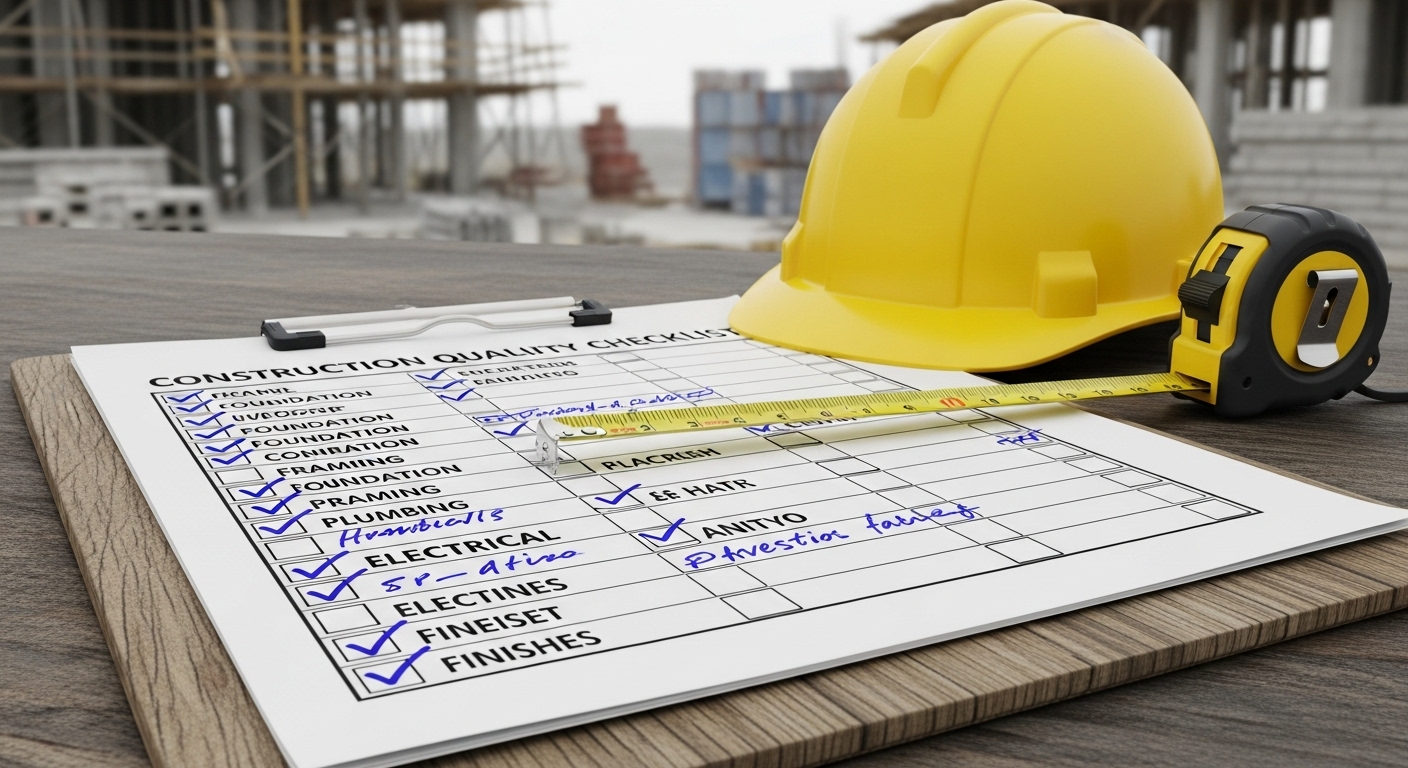
Quality failures on construction sites rarely happen all at once. They build quietly through missed inspections, rushed approvals, unclear standards, and undocumented decisions. Industry research shows that poor quality and rework typically consume 5–15% of total construction costs, significantly increasing delivery time and reducing asset value, according to analysis published by McKinsey & Company. Their construction productivity studies highlight rework as one of the largest hidden drains on project performance worldwide. In markets like Nigeria, where cost pressure, material variability, and tight schedules collide, a clear construction quality control checklist is no longer optional. It has become one of the most effective tools for protecting value, safety, and long-term asset performance.
Across many projects, the same issues repeat themselves. Site inspections happen inconsistently. Quality checks depend too much on individuals rather than systems. Documentation gaps make defects hard to trace. Regulatory compliance becomes reactive instead of planned, exposing projects to delays from agencies such as the Standards Organisation of Nigeria and state development authorities. Over time, these small gaps lead to structural defects, client disputes, failed handovers, and avoidable maintenance costs that follow a building throughout its lifecycle.
This page brings clarity to that challenge. It explains how to use a practical construction quality control checklist to manage inspections, approvals, and documentation at every project stage. It also includes a downloadable template designed from real project experience at Dutum Construction. The goal is simple: help project teams move from reactive fixes to disciplined quality systems. Our approach reflects a core belief that quality is not inspected in at the end, but built deliberately from the first drawing to final handover.
Also See: 5 Types of Construction Procurement Methods and How to Choose
12 Construction Quality Control Checklist
#1. Pre-Construction Quality Control Checklist
This stage confirms that the project is legally compliant, technically sound, and professionally staffed before site activities begin. This stage sets the foundation for cost control, safety, and build quality before site activities begin. Projects that skip this stage often struggle with rework, approval delays, and disputes.
Approved construction drawings and specifications ensure everyone builds from the same technical intent. In Nigeria, drawings should align with the National Building Code and receive approval from relevant planning authorities such as the Lagos State Building Control Agency or equivalent state agencies.
What Quality Control Focuses On at This Stage
| Area | What Quality Control Covers | Why It Matters |
| Design verification | Drawings are cross-checked against specifications and project objectives | Prevents conflicts between architectural, structural, and MEP designs |
| Contract clarity | Contract terms are reviewed for scope, timelines, responsibilities, and penalties | Reduces disputes and unclear obligations |
| Site investigation review | Soil reports are checked for bearing capacity, groundwater level, and soil type | Ensures foundations are safe and suitable |
| Regulatory approvals | Planning, environmental, and building approvals are confirmed | Avoids stop-work orders and legal penalties |
| Quality planning | A project-specific quality plan defines inspections, tests, and approval stages | Ensures consistent quality checks throughout construction |
| Safety readiness | Risk assessments and method statements are reviewed and approved | Reduces site accidents and legal exposure |
| Competency verification | Engineers, supervisors, and specialists are checked for licenses or certifications | Prevents technical errors caused by unqualified staff |
| Testing coordination | Approved labs are selected for concrete, soil, and material testing | Guarantees test results are credible and defensible |
#2. Material Quality Control Checklist
Material control ensures strength, durability, and safety, especially important where counterfeit or substandard materials are common.Material quality directly affects structural integrity, durability, and safety. Every material should receive approval before delivery to site, supported with supplier certificates and test reports.
Materials must comply with project specifications and Nigerian standards issued by the Standards Organisation of Nigeria. Cement storage in dry conditions prevents strength loss, while clean aggregates and rust-free steel protect concrete performance. Certified electrical and plumbing materials reduce fire, leakage, and maintenance risks. Proper site storage, labeling, and segregation prevent damage, theft, and misuse during construction.
Also See: How to Calculate Construction Materials
How Material Quality Is Controlled
| Material Area | Quality Control Action | Purpose |
| Pre-delivery approval | Samples and data sheets reviewed | Prevents unsuitable materials from reaching site |
| Supplier verification | Certificates and test reports confirmed | Filters out non-compliant suppliers |
| Cement handling | Dry, raised, and covered storage enforced | Maintains cement strength |
| Aggregates | Cleanliness and grading checked | Improves concrete performance |
| Steel reinforcement | Visual inspection and size confirmation | Prevents structural weakness |
| Blocks and bricks | Size and compressive strength checked | Avoids wall cracking and failure |
| Timber | Treatment and defect inspection done | Protects against rot and termites |
| Electrical and plumbing | Certification verified | Reduces fire and leakage risks |
| Storage control | Clear labeling and segregation | Prevents material misuse |
#3. Site Preparation & Earthworks Checklist
This stage protects the structure from settlement, flooding, and ground failure, which are common risks in many Nigerian soil zones. The soil investigation practices have to align with guidance from the Nigerian Society of Engineers.
Ground Quality Control Measures
| Activity | What Is Checked | Risk Controlled |
| Site clearing | Removal of roots, debris, and soft soil | Prevents future settlement |
| Setting-out | Coordinates and benchmarks verified | Avoids boundary and alignment errors |
| Excavation | Depth and width measured | Ensures correct foundation size |
| Soil strength | Bearing capacity confirmed | Prevents foundation failure |
| Excavation safety | Temporary supports inspected | Reduces trench collapse risk |
| Water control | Dewatering systems assessed | Prevents soil weakening |
| Compaction | Density tests reviewed | Ensures stable ground |
| Backfilling | Approved material used | Maintains foundation support |
| Level control | Horizontal and vertical alignment checked | Ensures structural accuracy |
| Records | Soil test reports archived | Supports audits and inspections |
#4. Concrete Works Quality Control Checklist
Concrete work determines the load-bearing strength and long-term durability of any structure, making quality control at this stage non-negotiable.
Thus, Concrete production must follow an approved mix design suited to site conditions and structural requirements. Slump tests carried out before placement confirm workability and help detect excess water, which weakens concrete strength. Reinforcement placement requires strict checks on spacing, size, and concrete cover to prevent corrosion and early failure.
Formwork alignment and stability directly affect structural accuracy. Poorly supported formwork often leads to honeycombing, misalignment, or collapse during pouring. Vibration must be controlled to remove air pockets without causing segregation.
Concrete curing must start immediately after the initial set. Adequate curing improves strength gain and reduces cracking, especially in Nigeria’s hot climate. Cube or cylinder tests validate compressive strength and are typically conducted through laboratories recognized by the Standards Organisation of Nigeria.
#5. Structural Works Quality Control Checklist
Structural works ensure the building performs safely under dead loads, live loads, and environmental forces.
Columns, beams, slabs, and load-bearing walls must align strictly with approved structural drawings. Reinforcement detailing and connections require careful inspection to confirm load transfer paths remain intact. Welding and bolting inspections reduce the risk of hidden structural weaknesses.
Structural tolerances must remain within allowable limits to prevent cumulative alignment errors. Temporary supports should only be removed after strength confirmation and engineer approval.
Formal inspections are often required before moving to subsequent construction stages, especially on regulated projects. Professional oversight typically aligns with standards promoted by the Nigerian Society of Engineers.
#6. Masonry & Blockwork Quality Control Checklist
Masonry quality affects structural stability, aesthetics, and finishing accuracy.
Blocks or bricks must meet specified strength and size standards. Mortar mixes require consistency to ensure proper bonding and load distribution. Regular checks on wall alignment, level, and thickness prevent uneven finishes and structural stress.
Openings for doors and windows must follow precise dimensions to avoid rework during finishing stages. Lintels must be installed correctly to carry wall loads above openings. Curing of masonry improves strength and reduces shrinkage cracks.
Quality inspections at this stage often support compliance reviews conducted by state building control agencies such as Lagos State Building Control Agency.
#7. Roofing Works Quality Control Checklist
Roofing protects the entire structure from weather damage, heat, and long-term deterioration, making quality control at this stage essential.
Roof structures must align accurately with approved drawings to avoid load imbalance and future sagging. Trusses require secure fixing and bracing to withstand wind uplift, which is common during Nigeria’s rainy season. Roofing sheets or tiles must be approved materials that meet durability standards, with correct overlap and fixing spacing to prevent water penetration.
Flashings and waterproofing details require careful installation at junctions, valleys, and roof edges, as these areas are the most common sources of leaks. Drainage slopes must allow rainwater to flow freely into gutters and downpipes. Leak testing after installation confirms performance before ceilings and finishes begin.
Roofing materials and installation practices generally align with standards issued by the Standards Organisation of Nigeria.
Also See: 12 Tips for Effective Construction Site Management
#8. Electrical Works Quality Control Checklist
Electrical quality control focuses on safety, reliability, and regulatory compliance. Hence, electrical installations must follow approved drawings and be handled by certified electricians to reduce fire and shock risks. Correct cable sizing ensures circuits can safely carry design loads without overheating. Earthing and bonding protect occupants and equipment from electrical faults.
Conduits and trunking should be neat, secure, and accessible for maintenance. Distribution boards require clear labeling for easy fault isolation. Insulation resistance and load tests confirm system integrity before commissioning.
Electrical installations in Nigeria operate under safety frameworks regulated by the Nigerian Electricity Regulatory Commission.
#9. Plumbing & Mechanical Works Quality Control Checklist
Plumbing and mechanical systems support health, hygiene, and building functionality.
Installations must follow approved drawings to avoid clashes with structural and electrical elements. Correct pipe materials and gradients ensure efficient water supply and drainage. Poor slopes often cause blockages and backflow problems.
All joints must remain leak-free under pressure testing before concealment. Sanitary fixtures and vent pipes require proper positioning to prevent odors and pressure buildup. Water quality testing confirms suitability for use, especially on large residential or commercial projects.
Access points for maintenance reduce future repair costs and downtime. Plumbing standards and water quality practices commonly align with guidance from agencies such as the National Environmental Standards and Regulations Enforcement Agency.
#10. Finishing Works Quality Control Checklist
Finishing works determine how users experience the building and how well it ages over time.
Plaster thickness must remain uniform to avoid cracks and uneven surfaces that show through paint. Surface finishes require smoothness and proper curing before painting or tiling begins. Paint type, color, and application method should follow approved samples to ensure durability and consistency.
Tiles need straight alignment and even spacing to prevent hollow sounds and premature failure. Doors and windows must fit squarely to avoid air leakage and operational issues. Fixtures such as handrails, fittings, and accessories require secure fixing to withstand daily use.
Final cleaning exposes hidden defects, while a properly closed snag list confirms that minor issues do not become post-handover disputes. Finishing quality often reflects compliance with local building control approvals issued by state planning authorities such as the Lagos State Physical Planning Permit Authority.
#11. Health, Safety & Environmental Checklist
Health, safety, and environmental control protect lives, property, and project continuity.
Personal protective equipment must be available and actively used on-site to reduce injuries. Clear safety signage improves awareness, while emergency procedures ensure quick response to incidents. Fire extinguishers and alarms must remain accessible and functional at all times.
Waste management controls reduce environmental impact and maintain site order. Noise and dust suppression protect workers and the surrounding communities. Scaffolding and lifting equipment require routine inspection and certification to prevent collapse or mechanical failure.
Safety inspections and records support compliance with Nigerian labor and environmental laws enforced by the Federal Ministry of Labour and Employment and the National Environmental Standards and Regulations Enforcement Agency.
#12. Final Inspection & Handover Checklist
Final inspection confirms that the project meets contractual, technical, and regulatory requirements.
All works must match approved drawings and specifications before inspection. Defects identified during review should be fully corrected, not deferred. Testing and commissioning verify that electrical, mechanical, and safety systems perform as intended.
As-built drawings and operation manuals support long-term facility management. Warranty documents protect the client against early system failure. Client walkthroughs allow final confirmation of quality before acceptance.
Completion certificates issued by relevant authorities formally close the project and permit occupation. Successful handover reflects disciplined quality control and strengthens trust between the contractor and client.
Download the QA/QC Template
Download the Dutum Construction QA/QC Checklist Template
Frequently Asked Questions
Quality control in construction is the systematic process of ensuring that construction work meets approved drawings, specifications, standards, and regulatory requirements. It focuses on preventing defects, ensuring safety, and delivering durable structures that comply with the National Building Code and relevant state building regulations.
A quality checklist in construction is a structured list of inspection points used to verify that each stage of work meets defined quality standards. It guides site teams through required checks, helps detect issues early, and ensures consistency across construction activities from start to finish.
A QC checklist, or Quality Control checklist, is a practical inspection document used to confirm that materials, workmanship, and processes comply with project requirements. It also provides documented evidence of compliance for audits, certifications, and final project handover.
The four pillars of quality control are planning, execution, inspection, and documentation. Planning sets quality standards and procedures, execution ensures work follows approved methods, inspection verifies compliance through checks and testing, and documentation records results, approvals, and corrective actions.
The four types of quality control in construction include pre-construction quality control, material quality control, process or workmanship quality control, and final inspection quality control. Each type plays a critical role in maintaining quality throughout the project lifecycle.
Construction quality control tools include inspection and test plans, quality control checklists, material approval records, laboratory test reports, site inspection logs, non-conformance reports, and as-built drawings. Digital QA/QC systems and standardized templates further improve accuracy, accountability, and compliance on complex projects.
Leave a Reply