


Construction projects rarely fail because of poor design alone. Most projects fail quietly through unmanaged changes. Construction change order management has become one of the most critical skills in today’s building environment, where shifting client needs, design clarifications, regulatory updates, and market volatility collide on active sites. Industry research shows that change orders can increase total project cost by 5–15% and extend delivery timelines when poorly controlled, according to insights shared by the Project Management Institute. Across Nigeria’s construction sector, delayed approvals, incomplete drawings, and late client decisions continue to turn small changes into major financial risks.
Pressure builds quickly once changes start piling up. Cost certainty weakens when variations are issued without proper evaluation. Site productivity drops when work stops for redesign or instruction clarifications. Disputes emerge when the change of ownership is unclear or documentation is weak. Cash flow suffers when approved variations are not tracked or valued correctly. Quality also declines when teams rush to absorb changes without proper planning. These challenges affect developers, contractors, and consultants alike, especially on fast-moving projects where timelines and budgets are already tight.
This page explains practical ways to manage construction change orders effectively, supported with a ready-to-use template. It breaks down how disciplined processes, early evaluation, clear documentation, and structured approvals protect project value. Drawing from real project experience, the guide reflects the systems-driven approach we use, where change is treated as a controlled process rather than a site disruption. The result is predictable delivery, protected budgets, and stronger stakeholder confidence even when change becomes unavoidable.
Also See: 12 Construction Quality Control Checklist (With Downloadable Template)
20 Ways to Manage Construction Change Order Effectively

#1. Establish a Clear Change Order Procedure in the Contract
A robust change order procedure starts at the contract stage. Contracts should explicitly define how change requests will be submitted, evaluated, and approved. This ensures that all stakeholders, owners, contractors, and consultants, understand the steps, timelines, and responsibilities involved. For public projects in Nigeria, adherence to the Public Procurement Act, 2007, ensures that any modifications remain compliant with federal procurement standards. Clear procedures prevent misunderstandings and reduce disputes, protecting both project timelines and budgets.
#2. Define What Qualifies as a Change Versus Contract Scope
Not every adjustment on site is a change order. Establishing what constitutes a true change versus routine scope variation is critical. This involves separating minor on-site adjustments from modifications that alter design intent, project cost, or schedule. Properly defining this ensures accountability and avoids unauthorized work that could inflate costs or create delays. It is also aligned with international best practices in construction project management and is essential for audits by bodies such as the Council for the Regulation of Engineering in Nigeria (COREN) for engineering compliance.
#3. Capture All Change Requests in Writing
All change requests should be documented in writing. Oral approvals or informal instructions often lead to disputes and cost overruns. Written documentation creates a clear audit trail that can be referenced during project review, cost evaluation, and regulatory inspections. This aligns with best practices in construction contracts under Nigerian law, especially when working with public sector clients who may require submission of all variations for approval by project monitors.
#4. Assess Cost and Time Impact Before Approval
Evaluating the financial and scheduling impact of a change is essential before authorization. This includes updating budgets, cash flow projections, and timelines to reflect the proposed modification. Tools like a project Gantt chart or cost-tracking software can quantify the effect of changes. In Nigeria, consulting firms often adhere to the Nigerian Institute of Quantity Surveyors (NIQS) guidelines for assessing variations in cost and time. Early evaluation prevents unplanned overruns and ensures informed decision-making.
Also See: The Importance of Quality Control in Construction: Ensuring Safety, Compliance, and Excellence
#5. Require Supporting Drawings and Specifications for Changes
Change requests must be accompanied by detailed drawings, technical specifications, and relevant documentation. This ensures that execution matches the intended design and prevents misinterpretation on site. In high-value Nigerian projects, such as institutional or commercial buildings, adherence to standards from the Standards Organisation of Nigeria (SON) for materials and construction practices ensures quality and compliance with national regulations. Supporting documents also facilitate approval processes and future audits.
#6. Maintain a Centralized Change Order Register
Keeping a centralized register of all change orders ensures that every modification is tracked consistently. This register records the date of request, description, originator, cost impact, and approval status. Centralized documentation improves transparency, allows project managers to monitor trends, and reduces disputes. Nigerian public projects often require proper record-keeping for audit purposes under the Public Procurement Act, 2007. For private projects, a change order register ensures contractors, clients, and consultants have a single source of truth, helping avoid miscommunication or double-counting of changes.
#7. Link Change Orders to Updated Schedules
Every approved change order should be reflected in the project schedule. Adjusting timelines ensures that dependencies are managed, critical paths updated, and resource allocations revised. Tools like Microsoft Project or Primavera P6 are widely used in Nigeria to integrate schedule adjustments with change orders. Linking changes to schedules helps stakeholders visualize the impact of modifications on project completion dates and supports compliance with internal quality assurance procedures.
#8. Approve Changes Before Execution Whenever Possible
No work should begin on a change order until it is formally approved. Unauthorized work increases risk of disputes, cost overruns, and delays. For government or institutional projects in Nigeria, approval may also require submission to regulatory bodies or project monitors for review. Ensuring approval before execution protects contractual compliance, aligns with the Nigerian Institute of Quantity Surveyors (NIQS) variation guidelines, and guarantees that costs are authorized and documented.
#9. Assign Clear Responsibility for Initiating and Approving Changes
Every change order must have designated personnel responsible for initiating, reviewing, and approving it. This avoids confusion and ensures accountability. Typically, the project manager, quantity surveyor, and client representative share oversight roles. In Nigeria, adherence to COREN and NIQS standards ensures that only qualified professionals handle technical and cost approvals. Clear responsibility minimizes errors, prevents unauthorized changes, and supports disciplined project governance.
#10. Track Cumulative Impact of Multiple Changes
Monitoring the cumulative effect of multiple change orders is essential to prevent budget and schedule creep. Even small modifications, if not tracked collectively, can significantly impact project outcomes. Using the centralized register and cost-control software, project managers can calculate overall cost increases, revised timelines, and resource needs. Tracking cumulative changes also helps Nigerian contractors demonstrate compliance with contracts and regulatory reporting requirements.
#11. Update Budgets and Cash Flow Forecasts Immediately
Every approved change order must trigger an immediate update to the project budget and cash flow forecasts. This ensures that financial planning remains accurate and prevents surprises in payments to contractors or suppliers. In Nigeria, compliance with the Public Procurement Act, 2007 and internal financial governance policies requires that cost modifications are documented and reflected in accounting records. Updating budgets promptly helps project managers anticipate financing needs, manage contingency reserves, and maintain overall cost control.
#12. Communicate Approved Changes to All Site Teams
Clear communication of approved change orders to all teams on site is critical. This prevents unauthorized work, ensures everyone is aligned with the latest specifications, and reduces mistakes that could lead to rework. Project supervisors, engineers, and subcontractors should receive updated drawings, instructions, and timelines. For Nigerian projects, maintaining communication records supports compliance during inspections by regulatory bodies such as the Nigerian Building and Road Research Institute (NBRRI) or client-appointed project monitors.
#13. Integrate Quality and Safety Checks into Change Execution
Every change order must consider quality assurance and safety protocols before and during execution. Modifications can affect structural integrity, electrical systems, or plumbing installations, and unsafe implementation can lead to accidents or project delays. Nigerian contractors should align with National Building Code of Nigeria standards and OSHA-equivalent local regulations to ensure safety compliance. Integrating checks ensures the project remains safe, meets design standards, and avoids costly post-completion defects.
#14. Use Standardized Change Order Templates
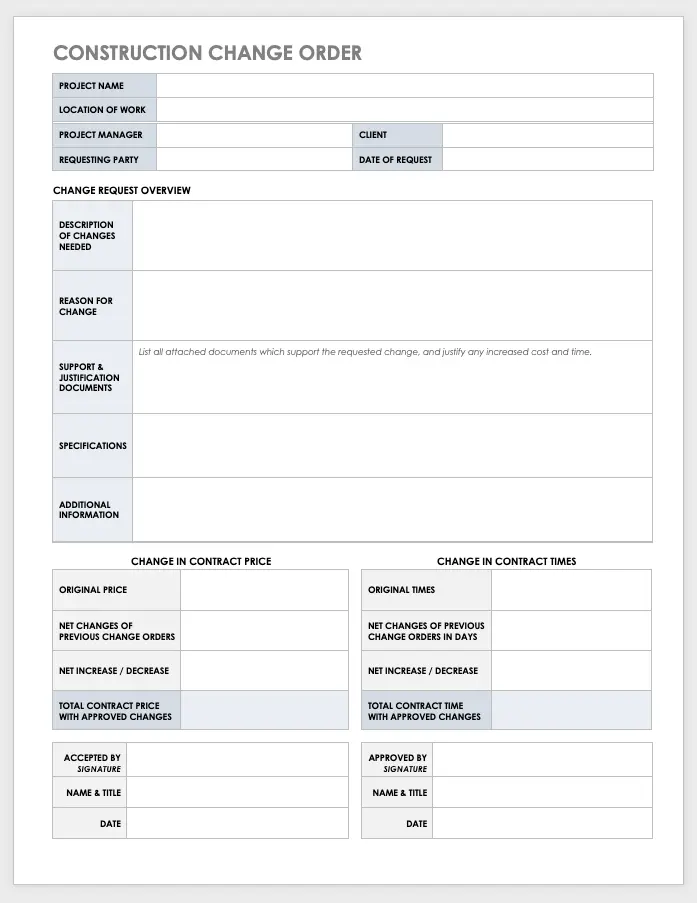
Implementing standardized templates for change orders improves consistency, reduces errors, and makes tracking easier. Templates should capture requester details, description, cost impact, schedule impact, approvals, and signatures. Standardization aligns with best practices recommended by the Nigerian Institute of Quantity Surveyors (NIQS) and helps both public and private projects maintain legal and audit-ready records. Templates also speed up approval and reduce miscommunication.
#15. Conduct Regular Change Order Reviews
Regular reviews of all change orders allow project teams to monitor trends, cumulative cost impact, and schedule deviations. Monthly or milestone-based reviews ensure that small changes do not escalate into major issues and that lessons are learned for future projects. This process supports accountability, encourages proactive planning, and aligns with the Nigerian Project Management Best Practice Guidelines, ensuring that changes are systematically analyzed and managed.
#16. Resolve Disputed Changes Early Through Documentation
Disputes over change orders can escalate costs and delay projects if not handled promptly. Maintaining clear documentation of all change requests, approvals, and communications helps resolve disagreements quickly. In Nigeria, having signed change order forms, supporting drawings, and cost impact records aligns with best practices recommended by the Nigerian Institute of Quantity Surveyors (NIQS). Early resolution protects relationships with contractors, prevents legal claims, and keeps projects on schedule.
#17. Align Change Management with Procurement and Material Orders
Change orders often affect material requirements and procurement schedules. Linking change order approval with updated procurement plans ensures that materials arrive on time and in the correct quantities. This minimizes delays, avoids overstocking, and reduces waste. For projects involving public funding or private investors, compliance with the Public Procurement Act, 2007 ensures accountability when material costs shift due to changes.
#18. Include Regulatory and Approval Timelines in Change Evaluation
Every proposed change should consider regulatory requirements, permits, and approval timelines. In Nigeria, some changes may require updated approvals from agencies such as the Nigerian Urban and Regional Planning Commission (NURPC) or the Lagos State Building Control Agency (LASBCA). Evaluating these timelines before implementing changes prevents legal or compliance issues that could halt construction and increase costs.
#19. Close Out Change Orders Formally After Execution
After a change is implemented, a formal closeout process confirms that all work, approvals, and cost adjustments have been completed. This includes updating schedules, recording budget impacts, and obtaining final approvals. Formal closeout ensures that the project remains auditable, supports handover documentation, and allows contractors and clients to have a clear record of completed modifications.
20. Review Lessons Learned to Reduce Future Variations
Analyzing completed change orders provides insights to minimize future variations. Regular lessons-learned reviews highlight recurring design gaps, approval delays, or cost misestimations. Nigerian construction teams can integrate these insights into contract templates, design reviews, and project planning to reduce unnecessary change orders. Continuous improvement in change order management improves efficiency, reduces disputes, and enhances predictability for all stakeholders.
Construction Change Order Template
You can download this template from Dutum Construction Change Order Template (Download), alternatively, you can as well draw insight from the template below;
Frequently Asked Questions
Construction change order management is the process of documenting, evaluating, approving, and tracking any changes to the original project scope, design, or specifications. Effective management ensures that changes do not compromise budget, schedule, quality, or safety while keeping all stakeholders informed.
Change orders typically include design changes, unforeseen site conditions, regulatory or permit updates, client-requested modifications, and adjustments to material or labor specifications. Each type must be clearly documented, costed, and approved before execution.
Project managers, site engineers, and the client’s representatives share responsibility for initiating, approving, and tracking change orders. Contractors, procurement teams, and QA/QC personnel ensure that changes are executed correctly and safely.
Standardized change order templates, integrated project management software, and QA/QC systems help capture all changes, track approvals, and provide audit trails. Templates simplify communication between contractors, clients, and suppliers while ensuring compliance with Nigerian regulations and industry standards.
Leave a Reply